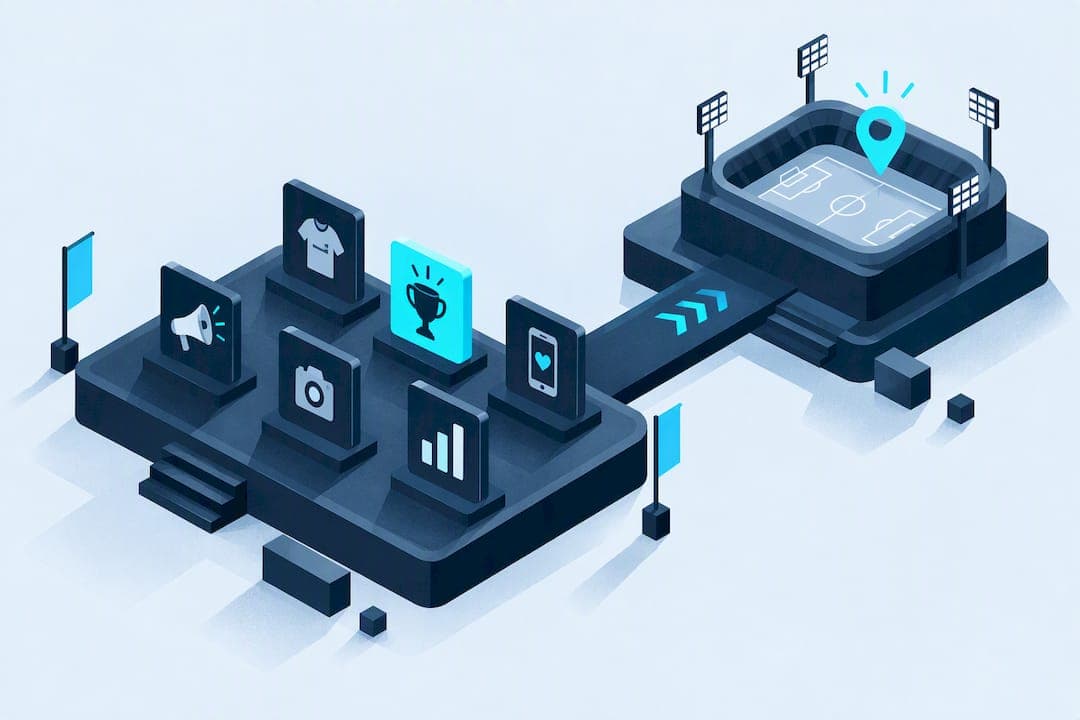
The highest-impact approach is to segment your fans and run a mix of in-venue experiences, digital activations, and loyalty loops that reward repeat participation. Start with gamified loyalty points, live fan voting, and seat-side mobile ordering, tactics known to work across sports and budgets. The sections below group practical ideas by channel, and show how to measure what actually moves the needle.
TL;DR:
- Segment fans by attendance history, favorite player, and content preference before spending; match each group with a channel and offer suited to its budget.
- Integrate seat ordering with existing point of sale systems, test screen reader access, and protect venue network capacity during halftime sharing spikes.
- Choose a KPI before launch, test one game or a campaign lasting two weeks against the prior month, and retire flat activations after two cycles.
- Let attendance, social sharing, and surveys earn points in one balance, but verify activity before issuing valuable rewards to limit fraud.
- For video and fan spotlights, track saves, shares, and comment depth rather than raw views; these measures indicate active audience response.
Table of Contents
- 1. Top fan engagement ideas grouped by channel
- 2. In-venue experiences that increase attendance and dwell time
- 3. Digital and social activations that scale engagement beyond game day
- 4. Loyalty, gamification, and rewards programs
- 5. Community events, fan clubs, and year-round programming
- 6. Content and storytelling: emotional hooks that build identity
- 7. Measuring impact: KPIs, quick tests, and iteration
- 8. How community-driven voting and arenas amplify engagement
- 9. Six rules of thumb for faster wins
- An alternative: run fan-driven competitions with The Push Arena
- FAQ
- Sources
1. Top fan engagement ideas grouped by channel
Picking the right tactic starts with knowing which channel matches your audience and budget. Segmenting fans first, rather than running one program for everyone, is the step that Deloitte's fan engagement research and industry guidance on sports marketing strategy both point to as the foundation for everything that follows.
In-venue experiences
- Mobile seat ordering: lets fans order food without leaving their seats; best for season-ticket holders; track concession spend per attendee.
- Interactive kiss-cam style polls on the jumbotron: works for casual and family audiences; needs a simple app integration; track participation rate.
- AR scavenger hunts in concourses: fits younger demographics and sponsors looking for brand visibility; track completion rate and dwell time.
Digital and social 4. Live in-game polls on social apps: engages remote fans during broadcasts; needs a social media manager on shift; track engagement rate. 5. Hashtag challenges tied to milestones: fits any budget; needs a clear call to action; track reach and user-generated post volume. 6. Second-screen companion content: deepens engagement for fans watching at home; requires app development investment; track watch time.
Loyalty and gamification 7. Points-for-attendance programs: rewards repeat visits; fits season-ticket holders and local fans; track redemption rate. 8. Badge and tier systems: gives casual fans a reason to come back; low setup cost; track tier progression. 9. Leaderboards for top contributors: works well for community-driven brands; needs a visible display; track active participants per week.
Community and events 10. Watch parties at local bars or community centers: fits markets with dispersed fan bases; low cost; track attendance and repeat visits. 11. Fan ambassador programs: builds word-of-mouth; needs a vetting process; track referral conversions.

Content and storytelling 12. Behind-the-scenes video series: builds identity between games; needs a content calendar; track saves and shares. 13. Fan spotlight features: low cost and builds community pride; track comment depth.
Low-cost quick wins 14. Birthday shoutouts and milestone recognition: nearly free; track opt-in rate. 15. User-generated content reposts: builds goodwill at no cost; track tag volume.
The in-venue and app-based ideas scale well for teams with budget and existing infrastructure. The community and low-cost options work as pilots for smaller organizations testing what resonates before investing further.
2. In-venue experiences that increase attendance and dwell time
Getting fans to stay longer and spend more inside the venue depends on removing friction, not adding spectacle for its own sake. Mobile seat ordering is the clearest example: when integrated with existing point-of-sale vendors, it cuts concession lines and keeps fans in their seats during play, which raises both dwell time and spend per visit. Accessibility matters here too, menus and ordering flows need to work for fans using screen readers or limited mobility, not just the tech-savvy segment.
Connectivity is the quiet infrastructure behind almost every other in-venue idea. Second-screen activations, live polls, and social sharing all fail without reliable Wi-Fi, and slow networks push fans to disengage rather than post.
- Seat delivery and mobile ordering: integrate with existing point-of-sale systems and test accessibility with real users before launch.
- Venue Wi-Fi: prioritize bandwidth during peak moments like halftime, when sharing spikes.
- AR and interactive exhibits: pair with a sponsor to offset setup costs and keep the experience simple enough for a quick concourse visit.
Pro Tip: Measure in-venue success with dwell time, concession spend per attendee, and a short post-game NPS survey sent within an hour of the final whistle.
3. Digital and social activations that scale engagement beyond game day
Apps and social channels are where fan engagement lives between games, not just during them. A well-built fan app earns its place on a phone's home screen through push notifications that feel personal rather than generic, paired with content flows that adjust based on what a fan has already engaged with. Cross-promotion between the app, social channels, and email keeps a single campaign working across every touchpoint instead of living in isolation.
Social-first activations remain one of the most accessible ways to reach fans who never set foot in the venue. Live Q&As with players, real-time polls during broadcasts, hashtag challenges tied to milestones, and physical or digital social walls at events all give fans a reason to participate rather than just scroll. Choosing which platform to prioritize should follow where your specific audience actually spends time, since social media usage patterns vary significantly across platforms and demographics.
- Fan apps: use push notifications sparingly and personalize content based on past interactions.
- Social-first activations: run live polls and hashtag challenges tied to specific game moments.
- Basic segmentation: capture attendance history, favorite player, and preferred content type to personalize outreach.
Track daily and monthly active users, engagement rate per post, and watch time on video content to see which activations are actually working.
4. Loyalty, gamification, and rewards programs
A loyalty program only works when it rewards behavior fans already want to repeat, not behavior they have to be bribed into. Points for attendance, tiers that unlock better perks, badges for milestones, and leaderboards that publicly recognize top contributors all give fans a reason to keep showing up, whether that means buying tickets, sharing posts, or showing up to community events. Our Raider Leaderboard model shows how public recognition of top contributors can drive sustained participation.
Letting fans earn points across channels, not just at the gate, extends the program's reach. Attending a game, sharing a post, or completing a survey can all feed the same point balance.
- Design elements: combine points, tiers, and experiential rewards like meet-and-greets rather than relying on discounts alone.
- Cross-channel earning: let online actions and in-venue attendance feed the same loyalty balance.
- Fraud and tracking: verify attendance and social actions before issuing high-value rewards.
Watch retention rate, redemption rate, and lifetime value uplift among enrolled fans versus non-enrolled fans to judge whether the program pays for itself.
5. Community events, fan clubs, and year-round programming
Fans don't stop caring when the season ends, and the organizations that keep a presence during the off-season see stronger return engagement when play resumes. Virtual watch parties, local pop-up events, and ambassador programs give fans low-pressure ways to stay connected without a game on the schedule. Familiar rituals and recurring community touchpoints tend to sustain participation better than one-off novelty events, since repetition builds the kind of cultural alignment that keeps people coming back.
- Virtual watch parties: fit remote or geographically spread fan bases at low cost.
- Ambassador programs: recruit superfans to represent the brand locally and track referral activity.
- Local pop-ups: build goodwill in specific neighborhoods or regions tied to the fan base.
Offer different entry points for superfans, casual followers, and local community members rather than a single blanket invitation, and measure community health through membership growth, retention, and sentiment in surveys or comments.
6. Content and storytelling: emotional hooks that build identity
Fans attach to teams through stories, not just scoreboards. Short-form video, serialized behind-the-scenes footage, nostalgia-driven throwbacks, and fan spotlight features all reinforce the identity that keeps someone a fan during a losing season. Ritualized moments, like pre-game traditions or major announcements, tend to produce short bursts of enthusiasm that only translate into lasting attachment when followed by sustained community activity.
- Short-form video: works across platforms and fits both game highlights and off-season content.
- Serialized behind-the-scenes series: schedule episodes to span the full season and carry into the off-season.
- Fan spotlights: feature real fans and their stories to build a sense of shared identity.
Track saves, shares, and comment depth rather than raw view counts, since those signals show whether content is actually building attachment.
7. Measuring impact: KPIs, quick tests, and iteration
Every activation needs one clear KPI before it launches, not a scorecard added afterward. Engagement rate, retention, revenue per fan, and NPS cover most of what matters, and tracking all four for every single initiative usually dilutes focus rather than sharpening it.
- Pick one core KPI per initiative before launch, such as redemption rate for a loyalty perk or completion rate for an AR activation.
- Run small tests first, limited to a single game or a two-week digital campaign, and compare results against a baseline from the prior month.
- Scale what shows a clear lift within the test window, and sunset anything that shows flat or declining engagement after two full cycles.
Quick iteration beats a perfect plan, especially for digital activations that cost little to test and even less to retire.
8. How community-driven voting and arenas amplify engagement
Public voting mechanics turn passive fans into repeat participants because every round gives them a reason to return and check results. When a platform lets fans showcase work, vote on favorites, and watch leaderboards update in real time, that loop mirrors the attendance and sharing patterns teams already try to build through loyalty programs.
- Fan-created contests: let supporters submit content and vote on winners, which drives repeat visits during the voting window.
- MVP or fan-choice awards: give audiences a stake in outcomes, which increases social sharing of results.
- Content curation through voting: surfaces fan favorites organically rather than through editorial picks alone.
These mechanics work best when paired with visible recognition, similar to how a public leaderboard reinforces participation over time.
9. Six rules of thumb for faster wins
Segment before you spend: a loyalty perk aimed at everyone usually lands with no one. Test small, scale fast: pilot a hashtag challenge for one home game before committing to a season-long campaign. Reward visible behavior: public recognition drives more repeat action than a hidden discount code. Design for social sharing: a poll result worth screenshotting spreads further than a plain announcement. Measure one KPI per initiative: clarity beats a dashboard full of numbers nobody checks. Keep year-round touchpoints: an off-season watch party keeps the connection alive until opening day.
— cameron
An alternative: run fan-driven competitions with The Push Arena
For organizers who want a lighter-weight way to test community voting without building the mechanics from scratch, we built the Push Arena around exactly that loop. Participants showcase their work, the community votes to decide who gets amplified, and the process stays transparent from entry to result, which gives overlooked creators and projects a real shot at visibility instead of waiting on an algorithm or a gatekeeper.

- Public voting rounds give fans a reason to return and check standings.
- Transparent approval keeps the process fair for creators entering the Arena.
- A visible leaderboard rewards consistent supporters alongside the creators themselves.
If your team wants to pilot a fan-voting activation without a custom build, enter the Arena and see how the format fits your community.
FAQ
What is the strategy of fan engagement?
The strategy is to segment fans by behavior and loyalty level, then match tactics, in-venue experiences, digital activations, loyalty rewards, to each segment rather than running one generic campaign. Deloitte's research identifies five tenets for this approach: knowing your audience, personalizing experiences, thinking holistically, engaging year-round, and recognizing loyalty.
What is an example of a fan engagement?
A loyalty program that awards points for attendance, social sharing, and app activity, redeemable for tiered perks like meet-and-greets, is a common example. Public voting contests, where fans choose a fan-of-the-month or help surface standout content, are another example that drives repeat participation.
How does fan engagement work?
Fan engagement works by giving fans recurring reasons to interact with a team or platform, through content, rewards, or participation, rather than relying on game-day attendance alone. Programs that combine in-venue experiences with digital touchpoints and loyalty rewards tend to sustain engagement because they create multiple entry points across a fan's week.
What is the fan engagement program?
A fan engagement program is a structured set of activities, often including loyalty points, exclusive content, community events, and digital activations, designed to keep fans connected between games and across seasons. Well-designed programs track clear KPIs like retention rate and redemption rate to judge whether the program is working.